New results from Alpha Magnetic Spectrometer (AMS) released
Source: SYSU News Center, School of Physics and Engineering
Written by: SYSU News Center, School of Physics and Engineering
Proofread by: Prof. He Zhenhui
Edited by: Wang Dongmei
Based on the analyzed 41 billion events detected by AMS (Alpha Magnetic Spectrometer) on the international space station (ISS), the AMS collaboration published their latest results in
Physical Review Letters on September 18, 2014. These results provide a deeper understanding of the nature of high energy cosmic rays and shed more light on the dark matter existence.
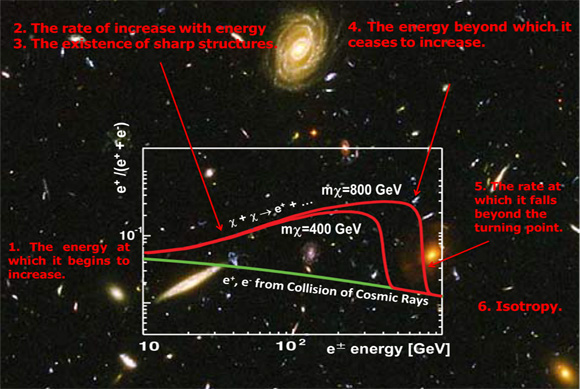
The published results can be summarized in three aspects. First, the measurements of the positron fraction (ratio of the number of positrons to the combined number of positrons and electrons) are more precise compared with the last published results (in April, 2013). AMS has measured the positron fraction at the energy as high as 500 GeV, and we can see that the excess positron fraction reaches the maximum around 275GeV; which is isotropic within 3%, a higher precision than before. Second, measurements of the electron flux and the positron flux (the number of particles passing per unit area per unit time) are significantly different from each other at different energy, which indicates the possible existence of a positron source different from most electrons, and this positron source does not come from a particular direction in space. We need more data to determine what this source really is. Third, the precision of the results published by AMS is much higher than that of similar experiments, and the results can fit to or exclude the existing models about cosmic rays and dark matter, thus deepening our understanding of cosmic rays. Although the results published this time cannot directly prove the origin of dark matter, the data obtained are more consistent with the predicted features of positron fraction produced by dark matter collisions than before.
AMS was assembled and tested at the European Organization for Nuclear Research (CERN), Geneva, Switzerland. Detector components were constructed at universities and research institutes around the world. Fifteen countries and regions from Europe, Asia and America participated in the construction of AMS (Finland, France, Germany, Netherlands, Italy, Portugal, Spain, Switzerland, Turkey, China, Korea, Taiwan, Russia, Mexico and the United States). The Principal Investigator of AMS is Prof. Samuel Ting of MIT and CERN. AMS is a U.S. Department of Energy sponsored particle physics experiment on the ISS under a DOE-NASA Implementing Arrangement. The Collaboration works closely with the NASA AMS Project Management team from Johnson Space Center as it has throughout the entire process. AMS was launched by NASA to the ISS as the primary payload onboard the final mission of space shuttle Endeavour (STS-134) on May 16, 2011. Once installed on the ISS, AMS was powered up and immediately began collecting data from primary sources in space and these were transmitted to the AMS Payload Operations Control Center (POCC). The POCC is located at CERN, Geneva, Switzerland.
After 40 months of operations in space, AMS has collected 54 billion cosmic ray events. To date 41 billion have been analyzed. The data is analyzed at the AMS Science Operations Center (SOC) located at CERN as well as AMS universities around the world. Over the lifetime of the Space Station, AMS is expected to measure hundreds of billions of primary cosmic rays. Among the physics objectives of AMS is the search for antimatter, dark matter, and the origin of cosmic rays. The Collaboration will also conduct precision measurements on topics such as the boron to carbon ratio, nuclei and antimatter nuclei, and antiprotons, precision measurements of helium flux, proton flux and photons as well as the search for new physics and astrophysics phenomena such as strangelets.
Sun Yat-sen University has participated in the AMS experiment and is responsible for the construction of TTCS as well as its on-orbit operational control and maintenance in the past three years after AMS was launched. The silicon tracker is the core SMD subdetector of AMS. Actually it is the unique magnetospectrometer among the subdetectors of AMS that can distinguish electrons from positrons. TTCS can provide a stable thermal environment for the tracker to make such high precision measurements possible.
At present, four PhD students from Sun Yat-sen University are studying and participating in the AMS data analysis at CERN, including antiproton spectrum and helium spectrum data analysis to be published in the future. In addition, a teacher and a master student are participating in on-orbit operational control and maintenance in AMS POCC at CERN.


 COPYRIGHT?1999-2017 , SUN YAT-SEN UNIVERSITY


