Lineage reprograming of resident astrocyte into functional neuron holds great promise and is a currently hotspot for neurological disease therapy.
In 2020, Prof. Xiangdong Fu's team from University of California, San Diego and Prof. Hui Yang's team from Shanghai Institutes for Biological Sciences, Chinese Academy of Sciences both reported through repressing one RNA binding protein-polypyrimidine tract binding protein-1 (PTBP1), astrocytes could be converted into dopaminergic neurons (DAns) in the substantia nigra or striatum, reconstructing the nigrostriatal circuit and improving motor deficit in a mouse model of Parkinson's disease(PD). These two groundbreaking studies provide promising therapeutic strategies and methods for PD and other neurodegenerative diseases, and have gained extensive attention in the field of neuroscience.
However, without adopting stringent lineage tracing method, these two studies were soon questioned about whether repressing PTBP1 could genuinely convert reactive astrocytes into DAns in a PD-related pathological state, which is of great therapeutic significance for PD patients.
On May 10, Prof. Mingtao Li's team from Zhongshan School of Medicine at Sun Yat-sen University published their latest research in eLife, titled “Repressing PTBP1 fails to convert reactive astrocytes to dopaminergic neurons in a 6-hydroxydopamine mouse model of Parkinson's disease”. This study provided convincing evidence that neither shRNA-mediated nor ASO-mediated PTBP1 repression could convert astrocytes into neurons including DAns either in physiological or PD-related pathological state. This study further confirms that the presence of the AAV-reporter positive neurons were resulted from virus leakage, which highlight the importance of using stringent and reliable lineage tracing strategy for studying in vivo neuronal reprogramming.
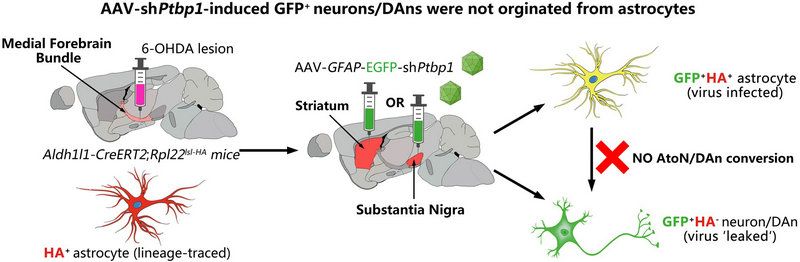
Weizhao Chen and Qiongping Zheng from Zhongshan School of Medicine at Sun Yat-sen University are the co first authors, and Associate Professor Shanshan Ma and Professor Mingtao Li are the co-correspondent authors of the paper. This research was supported by the National Natural Science Foundation of China (U1801681) and the the Key Realm R&D Program of Guangdong Province (2018B030337001).
Link to the article: https://elifesciences.org/articles/75636