Source: The First Affiliated Hospital
Edited by: Tan Rongyu, Wang Dongmei
Recently, the research groups of Prof. Lan Shao and Prof. Ling-wu Chen from The First Affiliated Hospital, Sun Yat-sen University co-published their latest research on prostate cancer immunotherapy entitled “ATM/NEMO signaling modulates the expression of PD-L1 following docetaxel chemotherapy in prostate cancer” in the
Journal for ImmunoThrapy of Cancer, one of the leading journals in the field of cancer immunotherapy. This work identified that docetaxel (DTX) chemotherapeutic treatment induced immune evasion in prostate cancer cells by upregulating the PD-L1 expression and showed a new immunosuppressive and tumor promoting function of activated ATM combined with NEMO in response to DTX chemotherapy.
As introduced by Prof. Ling-wu Chen, prostate cancer is the most common type of invasive cancer among men, and it is also the second leading cause of death. In our country, the incidence and mortality tendency of prostate cancer increased rapidly in the past ten years. PD-1/PD-L1 based immunotherapy has made significant breakthroughs in cancer treatment recently. However, reports on the PD-1/PD-L1 immunotherapy for prostate cancer are relatively disappointing. Therefore, a comprehensive analysis of PD-L1 expression under different medical and therapeutic conditions is necessary for the development of checkpoint inhibitors targeting prostate cancer.
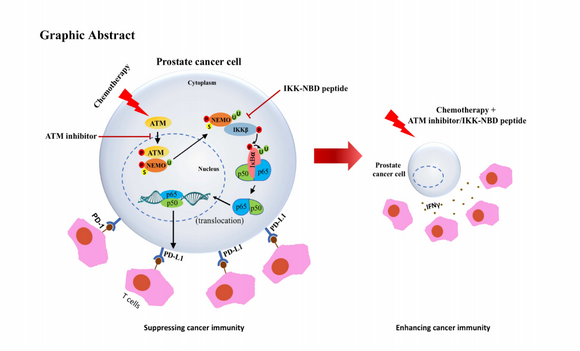
DTX-based chemotherapy is the first-line treatment of metastatic prostate cancer. The major limitation of DTX chemotherapy is the development of drug resistance, which is the primary cause of disease aggravation. This study first identified that PD-L1 expression was significantly higher in prostate cancer patients who received DTX treatment than in those who did not. Mechanism study indicated that ATM bound and phosphorylated NEMO, which results in NEMO SUMOylation, was a key step for NF-κB activation and PD-L1 expression. Using a fully mouse prostate cancer model and a humanized chimeric mouse bearing human prostate tumors, Prof. Shao and Prof. Chen further revealed how immune evasion induced by DTX contributed to the development of drug resistance of DTX and validated that the inhibition of NEMO and ATM along with DTX resulted in a significantly greater antitumor response than that of DTX alone.
In general, this study suggests that combination treatment with DTX and NEMO or ATM inhibitors can be exploited to develop a new therapeutic strategy to overcome cancer immune tolerance associated with the use of DTX, which providing an alternative to PD-L1 antibodies as a means of restoring cancer immunity. This might be of great benefit for patients resistant to antibody therapy.
Dr. Zongren Wang, a physican in the Department of Urology. Xueling Zhang (the Translational Medicine Center) and Wuguo Li (Experimental Animal Center) co-first authored this paper. The research was supported by the grant from the National Natural Science Foundation of China (NSFC) and the Hundred-Talent Program of Sun Yat-sen University.
Link to the paper:
http://dx.doi.org/10.1136/jitc-2020-001758