Source: School of Life Sciences
Edited by: Tan Rongyu, Wang Dongmei
Perfluoroalkyl substances (PFAS) are widely used in industrial manufacturing processes and consumer products due to their joint hydrophobic and oleophobic properties. These compounds are detected in many routinely used items during our daily life, such as coats, papers, food contact materials, cleansers, paints, etc. PFAS are hard to be degraded under natural environmental conditions and can also be detected in the environment, plants and wildlife. Human populations are exposed to PFAS via ingestion of drinking water and food, inhalation of air and dust, and contact with contaminated media. Emerging evidence suggested an accumulation of PFAS in the human body is associated with adverse health effects, including immune-related health conditions (like allergic diseases), metabolic dysregulation (like nonalcoholic fatty liver disease), and neurodevelopmental delays. Among the various PFAS, perfluorooctane sulfonate (PFOS) is the most common type studied in relation to human health and was added to the Stockholm Convention’s list of globally restricted Persistent Organic Pollutants in 2009 under United Nation Environment Programme.
Several studies have indicated that oxidative and inflammatory responses are involved in PFOS-induced cell injury and tissue damage. However, most experimental results about PFOS are based on descriptive studies and the mechanisms underlying PFAS-induced tissue inflammation remain poorly understood. One critical question is how PFOS is recognized in the cells and trigger cellular inflammatory responses.
In this study, researchers revealed both the acute and chronic PFOS exposure induce inflammatory cytokine production (IL-1β, TNF-α and IL-6) and tissue injury. Mechanistically, researchers found that the level of cytosolic Ca
2+ was obviously up-regulated in PFOS- treated cells. And the increase of cytosolic free Ca2+ contributes to the activation of downstream kinases (protein kinase C), leading to the activation of NF-κB signaling or JNK signaling. The phosphorylated JNK can promote BAX translocation to mitochondrial, leading to the interaction between BAX and CypD or BAK. BAX/BAK- and BAX/CypD-mediated pathway contributes to PFOS-triggered the mtDNA release, resulting in AIM2 inflammasome activation. They established PFOS acute exposure mouse model and PFOS-induced asthmatic exacerbation mouse model, then found that PFOS-induced tissue damage (liver, lung and kidney) and the inflammatory patterns under PFOS+OVA treatment were markedly reduced in
Aim2-/- mice, indicating that AIM2 inflammasome activation contributes to PFOS-induced tissue inflammation and asthmatic exacerbation.
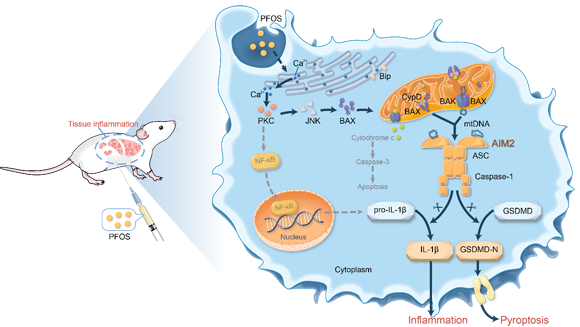
Fig. 1 Schematic diagram to illustrate the mechanisms that PFOS exposure induces AIM2 inflammasome activation to promote tissue damage through the Ca
2+-PKC-NF-κB/JNK-BAX/BAK-mtDNA axis.
Collectively, the researchers found that PFOS activates the AIM2 inflammasome in a process involving non-oxidized mitochondrial DNA release through the Ca
2+-PKC-NF-κB/JNK-BAX/BAK axis (Fig. 1). This research suggests a link between environmental organic pollutants (e.g., PFOS), intracellular danger signals (mtDNA) and sensor (AIM2 inflammasome) to the host effect (cellular inflammation and tissue damage), which is the essential mechanism triggering the PFOS-associated inflammatory diseases.
This work entitled "Perfluoroalkyl substance pollutants activate the innate immune system through the AIM2 inflammasome" was published online in the international prestigious journal
Nature Communications on May 18th, 2021. Prof. Jun Cui and Prof. Chun-Wei Li are the corresponding authors. Dr. Li-Qiu Wang is the first author. This research is supported by the National Natural Science Foundation of China.
Link to the paper:
https://www.nature.com/articles/s41467-021-23201-0