Source: Zhongshan Ophthalmic Center
Edited by: Tan Rongyu, Wang Dongmei
Achieving universal health requires breakthroughs in medical technologies and health management models. Among the numerous organs of the human body, the eye is the only body surface organ that can directly observe important structures such as arteries and nerves. Lesions of different systems could have characteristic manifestations in the eye, and AI diagnostic technologies based on ocular imaging will become the new ‘core’ of innovation medical treatment. Traditional medicine has showed that icteric changes in the conjunctiva and sclera have been observed in hepatobiliary diseases. However, these changes are limited in some disease categories, and other ocular manifestations associated with different hepatobiliary diseases are poorly understood. Additionally, these manifestations are neither specific nor substantial, further limiting their use as stand-alone diagnostic features.
Supported by the medical artificial intelligence innovation platform of Sun Yat-sen University, an international multicenter research program led by Haotian Lin (Zhongshan Ophthalmic Center)and Yuesi Zhong (the Third Affiliated Hospital, Sun Yat-sen University), was the first to develop a technique for screening and identifying hepatobiliary diseases through ocular imaging, which has been published in the top international journal
The Lancet Digital Health on January 26, 2021.
The research team successfully extracted the ocular features of hepatobiliary diseases from these imaging data via deep learning using slit-lamp and fundus images, and developed and tested 14 models (seven slit-lamp models and seven fundus models). The models can be used to screen for hepatobiliary diseases and identifying six categories of hepatobiliary diseases, including liver cancer, liver cirrhosis, chronic viral hepatitis, non-alcoholic fatty liver, cholelithiasis and liver cyst. The models achieved good performance in the diagnosis of severe liver diseases such as liver cancer and liver cirrhosis and relatively poor performance in milder disease such as chronic viral hepatitis, non-alcoholic fatty liver, cholelithiasis and liver cyst. These models have been successfully deployed on the intelligent diagnosis prediction cloud platform of Zhongshan Ophthalmic Center, Sun Yat-sen University, which could be applied as a big scale opportunistic screening tool.
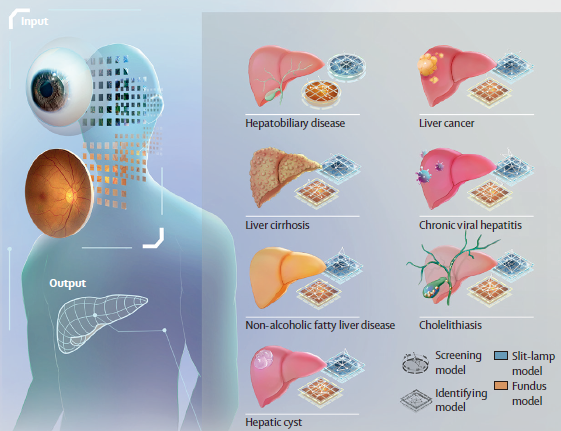
Figure 1. Using ocular imaging to screen and identify hepatobiliary diseases via deep learning

Figure 2. Interface of Hepatobiliary Disease Screening System of Intelligent Diagnosis and Prediction Platform of Zhongshan Ophthalmology Center, Sun Yat-sen University
?
To understand the mechanism of our models and minimize the black-box effect, the research team adopted several visualization techniques to highlight the abnormal areas recognized by the algorithms and did occlusion test and greying test. The test showed that in addition to the conjunctiva and sclera, the deep learning model revealed that the structures of the iris and fundus also contributed to the classification.
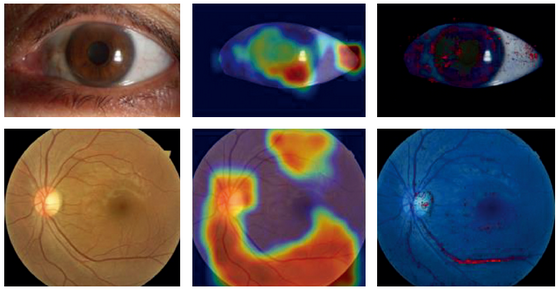
Figure 3. Heatmaps
This research work has been highly praised by domestic and foreign peers. The director of the internal medicine department and hepatobiliary chief expert Professor Vijay H Shah, from the well-known medical institutions (Mayo Clinic), made a comment and praised "This is the first study to propose an entirely new role for ophthalmological imaging to serve as a screening tool for early detection of hepatobiliary disorders ".
Prof. Haotian Lin (Zhongshan Ophthalmic Center) and Dr. Yuesi Zhong (the Third Affiliated Hospital, Sun Yat-sen University) are the corresponding authors. Wei Xiao (Zhongshan Ophthalmic Center), Xi Huang(the Third Affiliated Hospital, Sun Yat-sen University)and Jinghui Wang(Zhongshan Ophthalmic Center)are the co-first authors. Prof. Weirong Chen (Zhongshan Ophthalmic Center) and Prof. Yizhi Liu(Zhongshan Ophthalmic Center)are the co-senior authors. Prof. Zhiyong Guo (Organ Transplant Centre, The First Affiliated Hospital, Sun Yat-sen University), Wen Wen (National Centre for Liver Cancer, Eastern Hepatobiliary Surgery Hospital, Second Military Medical University), Carol Yim-Lui Cheung (Department of Ophthalmology and Visual Sciences, Chinese University of Hong Kong, Hong Kong), Ji-Peng Olivia Li (Moorfields Eye Hospital NHS Foundation Trust) and Yoshihiro Mise (Department of Hepatobiliary and Pancreatic Surgery, Cancer Institute Hospital, Japanese Foundation for Cancer Research) made significant contributions to this work. This research was funded by the Science and Technology Planning Projects of Guangdong Province (2018B010109008), the National Key R&D Program of China (2018YFC0116500), the Guangzhou Key Laboratory Project (202002010006).
Link (article):
http://www.thelancet.com/journals/landig/article/PIIS2589-7500(20)30288-0/fulltext
Link (comment):
http://www.thelancet.com/journals/landig/article/PIIS2589-7500(20)30319-8/fulltext