Source: School of Life Sciences
Written by: School of Life Sciences
Edited by: Tan Rongyu, Wang Dongmei
The world is suffered from an ongoing pandemic of 2019 novel coronavirus (Covid-19), which is caused by severe acute respiratory syndrome coronavirus 2 (SARS-CoV-2/2019-nCoV). By October 1st 2020, over 34 million cases were confirmed with a death toll at more than 1 million. During viral infection, type I interferon (IFN) responses serve as the first defensive line against invading viruses. Viral evasion from surveillance of immune system is considered as one of the important pathogenic mechanisms. It is of great significance to clarify the mechanisms employed by SARS-CoV-2 for evading from immune system.
Recently, Prof. Jun Cui’s team from School of Life Sciences at Sun Yat-sen University, together with Prof. Jincun Zhao’s team from the First Affiliated Hospital of Guangzhou Medical University published a research paper, entitled “Main protease of SARS-CoV-2 serves as a bifunctional molecule in restricting type I interferon antiviral signaling”. Their findings were published in
Signal Transduction and Targeted Therapy on October 7th 2020.
Although IFNβ pre-treatment was showed to effectively reduce the replication of SARS-CoV-2, SARS-CoV-2-induced IFNβ signaling was relatively low compared with other viruses, suggesting that SARS-CoV-2 could inhibit type I IFN production. In this study, researchers revealed the dual functions of SARS-CoV-2 Mpro in impairing virus-triggered type I IFN production and the induction of downstream ISGs. On one hand, Mpro can target RIG-I, the major viral RNA sensor in the cytosol, and inhibit the IFN induction by inhibiting the K63-linked ubiquitination of RIG-I. On the other hand, SARS-CoV-2 Mpro could also reduce the release of IFN-induced downstream antiviral cytokines by restricting IFN transduction signaling. SARS-CoV-2 Mpro could promote the autophagic degradation of key transcription factors STAT1, thus inhibiting nuclear translocation of STAT1 and restricting IFN transduction signaling.
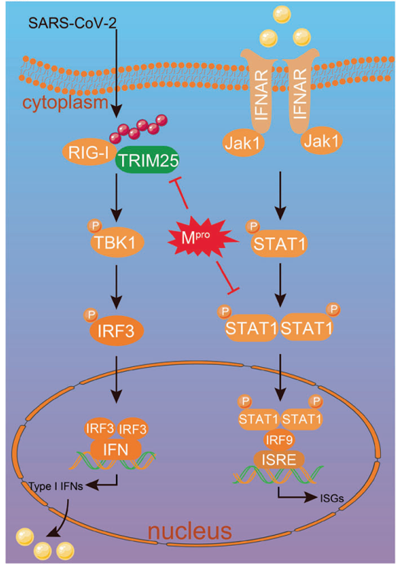
Figure 1. Main protease of SARS-CoV-2 restricts type I interferon antiviral signaling at multiple administrative levels.
Taken together, the researchers revealed the dual function of Mpro, the main protease of SARS-CoV-2, in impairing virus-triggered type I IFN production and the induction of downstream ISGs (Figure 1). By revealing the additional functions of SARS-CoV-2 Mpro, this finding may shed new light on understanding the immune evading mechanisms of SARS-CoV-2, which could provide novel targets for potential therapeutic intervention on SARS-CoV-2 infections.
Prof. Jun Cui and Prof. Jincun Zhao are the co-corresponding authors of this work. Dr. Yaoxing Wu, Dr. Ling Ma, Dr. Zhen Zhuang and Miss. Sihui Cai are the co-first authors. This research is supported by the National Natural Science Foundation of China.
Link to the paper:
https://www.nature.com/articles/s41392-020-00332-2