Source: Zhongshan School of Medicine
Written by: Zhongshan School of Medicine
Edited by: Wang Dongmei
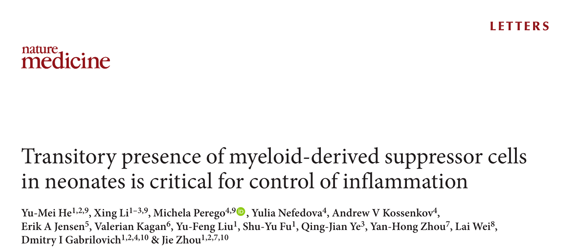
New research directed by Prof. Jie Zhou and Prof. Dmitry I. Gabrilovich from Institute of Human Virology, Zhongshan School of Medicine, Sun Yat-sen University, reveals that the transitory presence of immunosuppressive cells, that is myeloid-derived suppressor cells (MDSCs), plays critical role in the control of inflammation in neonates. This study suggests a potential therapeutic value of MDSCs in the treatment of inflammatory diseases in newborns. This study was published online in Nature Medicine on January 15, 2018.
MDSCs are immature myeloid cells with the potent capability to suppress immune responses. Accumulation of MDSCs was considered to be a consequence of certain pathological stimulations, inducing the immunotolerance to tumor cells or pathogens, therefore promoting tumor progression or infections. No or very few MDSCs are observed in steady-state physiological conditions.
The researchers found a significant elevation of MDSCs levels in 3-10 days newborn mice, when compared with adult and postpartum mice. These cells displayed strong capability to suppress T cell responses and gradually decreased to control levels at the end of 2 weeks.
Using the model of necrotizing enterocolitis (NEC), they showed that depletion of MDSCs increased the susceptibility of inflammation, while transfer of MDSCs suppress inflammation in newborn mice. “Our research shed light on the function of MDSCs in newborns, suggesting that they are critical for regulation of inflammation during the first weeks of life,” said Dmitry I. Gabrilovich, M.D., Ph.D.
Further and mechanistic studies showed that accumulation of MDSCs was driven by lactoferrin (LTF), a milk component with potent immunoregulatory activity. LTF could increase the expression of genes critical for the immunosuppressive functions of MDSCs, including nitric oxide, PGE2 and S100A9/A8, which contribute to controlling inflammation.
Importantly, the researchers further investigated the clinical relevance using human samples. They observed that human newborns with normal birth weight had significantly higher levels of MDSCs and higher immunosuppressive activity, when compared with adults. Infants with low birth weight, who are prone to NEC development, displayed reduced level of MDSCs and their immunosuppressive activity.
"Our findings demonstrate that MDSC reduce inflammation and increase survival in a model of necrotizing enterocolitis, thus suggesting that MDSCs not only can be present in healthy individuals but could also be an important protection mechanism evolved in response to the microbial colonization of the gut that takes place during the first days of life,” said Gabrilovich.
"Our study reveals a physilogical role of MDSC under steady-state condition, which broadens its importance in the immune system; meanwhile, MDSCs may be a potential therapeutic target for treating necrotizing enterocolitis and other inflammatory conditions in infants,” said Jie Zhou, M.D., Ph.D.
Jie Zhou and Dmitry I. Gabrilovich from Sun Yat-sen University, are co-lead author of this study. Yu-Mei He and Xing Li from Sun Yat-sen University and Michela Perego from The Wistar Institute contributed equally to this work as co-first authors.