Source: School of Life Sciences
Written by: School of Life Sciences
Proofread by: Yang Jianhua, Jiang Shuai
Edited by: Wang Dongmei
The four-day International Genetically Engineered Machine Competition (iGEM) 2013 World Championship Jamboree came to a close on the afternoon of November 4, 2013. The two teams from Sun Yat-sen University (SYSU), the bioinformatics team SYSU-Software and the experimental team SYSU-China, both won awards. SYSU-Software team was awarded the Best Software Project, the grand prize in the software division, as well as a gold medal. This is the first time for SYSU-Software to receive the highest software award after it won two prizes in the iGEM 2012 World Championship Jamboree. SYSU-China team received Best Wiki and entered the Finalists, winning the 2nd Runner-Up in the Overgraduate division. This is another historic breakthrough since SYSU teams participated in iGEM, and it is the best result of the Asia Regionals in the iGEM World Championship Jamboree.

SYSU-Software team won Best Software Project, the grand prize in the software division.
SYSU-China team won Best Wiki and the 2nd Runner-Up in the Overgraduate division of the Finalists.
The SYSU-Software team is made up of 16 undergraduates from School of Life Sciences, YAT-SEN School, School of Information Science and Technology, School of Software, School of Mathematics & Computational Science, School of Communication and Design and School of Engineering, including Miao Zong, Nie Peng, Xu Wang, Li Jianhong, Zhang Hong, Liu Xi, etc. The team has developed a software CAST (Computer Aided Synbio Tool) which can help users design regulatory networks and gene circuits with standard Biobricks and other regulatory elements. It also assists synthetics biologist by providing modeling, vector designing and experiment proposal. The team members presented the optimized and developed software system with confidence during the competition. Professor Douglas Densmore from the Boston University, the Chairman of Software Division, highly appreciated the SYSU-Software’s work. He thought that the CAST software was very comprehensive and systematic, which may contribute greatly to the development of synthetic biology. He also put the project of SYSU-Software onto the iGEM website. Professor Gil Alterovitz from Harvard Medical School and Massachusetts Institute of Technology (MIT) asked about the processes of designing and developing the software. He praised the teammates for their talents and abilities, and also invited them to participate in his interdisciplinary project on disease forecast. Moreover, the experimental teams of MIT and University of Ottawa have also sent their invitations to collaborate with SYSU-Software team.
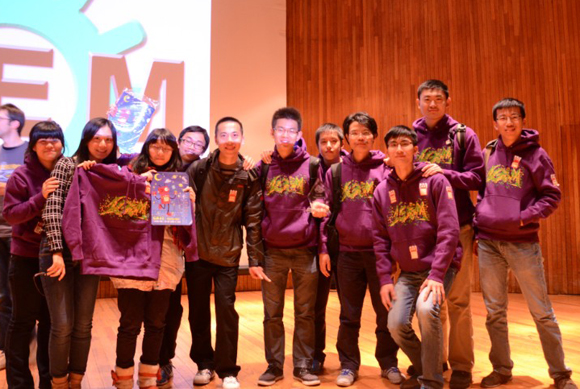
Group photo of SYSU-Software team after receiving the prize
The experiment team SYSU-China is composed of 15 undergraduates from School of Life Sciences, School of Mathematics & Computational Science and YAT-SEN School, including Sun Mengyi, Zhao Yuchen, Chen Haoqi, Lin Kaixuan, He Dawei and Fang Yiming. Since the technology of iPSCs (induced Pluripotent Stem Cells) is widely concerned these several years, its high potential risk of tumorigencity has become the largest hurdle for clinical trial. This summer SYSU-China created a new device (iPSCs Safeguard), which is composed of miRNA122 binding sites, suicide gene, and Tet-off system, to minimize this problem. iPSCs Safeguard is intelligently designed on the basis of synthetic biology which can reduce tumorigenic risk during the clinical therapy of the iPSCs. With this device, only correctly differentiated hepatocytes can survive, while other types of cells, including hepatomas and undifferentiated cells, will automatically commit suicide without affecting other normal cells around.
Earlier in the iGEM 2013 Asia Jamboree held at The Chinese University of Hong Kong, both SYSU-China team and SYSU-Software team stood out in the 65 participating teams. SYSU-China received a gold medal and two special awards (Best Model and Best New BioBrick Part, Natural) in the iGEM Asia Jamboree. Both teams advanced to the World Championship Jamboree held in MIT.
Since 2011 when SYSU teams participated in iGEM for the first time, they have entered the World Championship Jamboree (WCJ) competition for three consecutive years. The great success the SYSU team made in iGEM is the result of the promotion of practical teaching and multidisciplinary education of School of Life Sciences in recent years. These two SYSU teams have gathered the wisdom and strength of many teachers, students as well as functional departments. The instructors include Professor Lu Yongjun, Professor He Xionglei, Professor Ren Jian, Professor Zhao Yong, Associate Professor Yang Jianhua, Associate Professor Huang Junjiu, Associate Professor Huang Shengfeng, Senior Lecturer Zhang Yongdong, Lecturer Xu Hui and Lecturer Zheng Lingling. Among them, Associate Professor Yang Jianhua was even elected as a judge in the 2013 Asia Jamboree of iGEM. During the whole process, two teams received great support from the School of Life Sciences, Xiang Peng Lab of Zhongshan School of Medicine, State Key Laboratory of Biocontrol, The Key Laboratory of Gene Engineering of Ministry of Education, Sun Yat-sen University Biomedical Center, YAT-SEN school, School of Mathematics & Computational Science, School of Software, School of Information Science and Technology, School of Communication and Design, School of Engineering, University Dean’s Office, Student Affairs Office, SYSU Youth Association and Office of International Cooperation & Exchange.
Related Links:
iGEM started at MIT in 2003 and grew into an international competition in 2005 with the aim to promote the study, communication and cooperation in Synthetic Biology among the undergraduate students in the world. As a top-notch international science and technology competition for university students, iGEM receives high attention from the well-known journals such as
Nature,
Science and
Scientific American as well as media coverage including BBC. The competition has a great international influence.
In 2013, over 200 teams from more than 40 countries in the world, including the world-class universities such as MIT and Stanford University, participated in the iGEM competition. Among them, 65 teams from the universities in Asia competed in the iGEM 2013 Asia Jamboree, including The University of Tokyo, The University of Sydney, Indian Institute of Technology, The Hong Kong University of Science and Technology, The Chinese University of Hong Kong, National Yang-Ming University in Taiwan, Peking University, Tsinghua University, Fudan University, Shanghai Jiao Tong University and Sun Yat-sen University.