Source: Office for Overseas Promotion
Written by: Ian Heuer
Edited by: Wang Dongmei
When speaking with Khadijah Zakaeifar, an American Master’s degree student at SYSU, it is easy to make the assumption that she has had a lifelong interest in China and international affairs. She is a voluble and engaged conversation partner; her acumen and passion equally evident in her discussion of these topics. She displays an intellectual grasp on these issues that suggests an early-germinating and long-standing attraction. By her own admission, however, before an out of the blue invitation she received while an undergraduate, China was the furthest thing from her mind. “A professor asked me if I wanted to study abroad, a three-week summer exchange learning Chinese,” she said. "At first I didn’t think I could go, my mind was so closed. I didn’t know any Chinese at all, not even ‘1-2-3’ or ‘ni hao’." Prior to the invitation, Khadijah was two years into a degree in nursing at IUPUI, Indiana University-Purdue University Indianapolis. When she first got the opportunity to study abroad at SYSU in 2011, she saw her future in the medical services field. Fast-forward to today and she is studying for her Master’s degree in international relations. In the meantime, Khadijah had a range of experiences that would open her mind and deepen her engagement with and attraction to China and world affairs. She describes the initial study program in 2011 as the key moment in her academic life, “After arriving I became so passionate about China. I never had any Chinese friends or any interest in Chinese history or culture before, but then after coming here I just realized how na?ve many Americans are and how we live in a box and don’t even know that much about our own country, much less other countries.” Through her teachers and her friends at SYSU, Khadijah fell in love with the Chinese language, culture, and people. When the program was finished, she returned to Indiana, but the fire was not extinguished. Before long she would be back at SYSU for her second stint. “Someone told me about an exchange program for one year,” she said. “So before I graduated I took a year off and came here to study Chinese for two semesters in the language program.” After the initial month-long encounter, this year-long experience crystalized her interest in the country. After graduation, she was back again, her transition from short-term exchange student to year-long exchange student culminating with her decision to earn her Master’s degree as a full-time graduate student at SYSU.
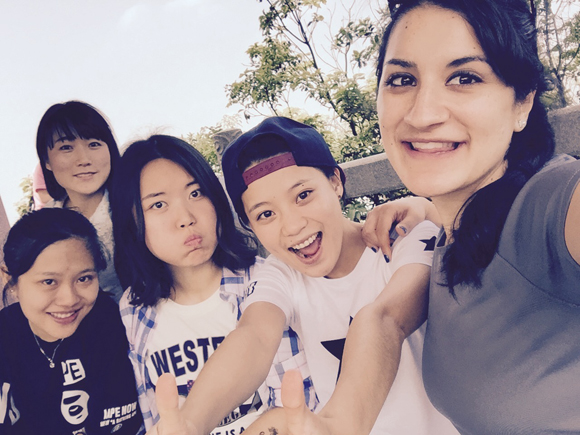
Khadijah (far right) and her classmates
Despite Khadijah’s background at SYSU, the transition to graduate student life wasn’t always smooth. She describes her first semester as a trial by fire, “I remember the first time I had to do a presentation and I had never studied these kinds of technical international relations or foreign policy words in Chinese.” Beyond the language challenges, there were also some cultural hurdles to clear. When that first presentation was over, Khadijah recalled thinking, “Ok you know, I’m a foreigner, the teacher will go easy on me.” In reality, the professor challenged her in front of the class, calling out mistakes in language and reasoning. Beyond the substance of the criticism, the mere fact that the teacher would raise objections so publically was outside Khadijah’s realm of experience. “In America, I feel like the teacher would wait until the end of class to say something” she said. “They would also take more pains to give positive feedback as well as criticism.” This experience had her feeling like a failure, but she soon received support from her brand new classmates, who assured her that it was standard practice for professors to issue feedback in this way. This discussion caused her to reevaluate her initial negative reaction to this criticism. “At first, I was hurt. I didn’t want to talk to that professor again or even look at him,” she said. “But after I talked to my classmates I realized that this is how the professor was showing that he cared about my development. He was not trying to be mean. It was his way of letting me know that I needed to try harder and could be accomplishing more.” By now, she has learned to embrace aspects of studying in China and Chinese, saying that her time here has caused her to develop and improved work ethic. “The intensity of the study atmosphere here is so much different. I always find myself thinking, ‘If I could go back and re-do my Bachelor’s degree, I would definitely be the number one student’.”
The cultural exchange created by Khadijah’s presence at SYSU is a two-way street. Not only has she learned more about Chinese culture, she has been able to influence her classmates. One of her main topics of study is China-U.S. relations. I asked whether she viewed herself as a grassroots-level manifestation of the relations between these two countries, or perhaps less abstractly as a representative of America abroad. “To be honest, sometimes I feel a little uncomfortable about that. A lot of times people see me as a representative of America and all that the country stands for,” she said. She described her ideas as her own and not always contiguous with what are believed to be mainstream American political and cultural beliefs. “I am the only Westerner in my class; Chinese students make up a majority and the other foreigners come from East or Central Asia,” she said. “So it often happens that when the class is looking for a ‘Western’ perspective on an event or issue, they turn to me. They then take my point-of-view as being ‘what Americans think’ instead of ‘what a particular American thinks.’ But I definitely don’t represent America as a whole.” It seemed to me that she serves as a representative of America not in the sense that she holds the same views as the mainstream American political establishment, but in the sense that she is an exemplar of the diversity and richness of the American intellectual tradition, having arrived at independent and well-considered opinions informed by both her background and experiences.
It turns out that while Khadijah’s transition to international relations, while abrupt, was not without precedent. Her father made a similar decision, traveling from his native Iran to earn his Master’s degree in the United States. He married an American and has lived there ever since. He currently works in Washington, D.C. in the foreign policy industry. Khadijah’s studies currently focus on topics related to climate change, how the U.S. works with and assists other countries, including China and Camobdia on climate issues. She said she could see herself working in the public sector in the future, representing American interests in China. To people interested in China and the world, she had some advice on how to find success abroad. “Be open and courageous,” she said. “A lot of people when thinking of moving abroad are too worried about every little thing going right. I’m here, I do stupid things all the time, I ask people about things I don’t know about. It’s important to be open about cultural differences. In America we can read books about China all day but not actually understand how the system works or how people think. Being in a classroom in close proximity with Chinese peers affords the opportunity to gain wisdom and experience in the real world.”